
HOWO TX 6x4 vs 8x4: A Sinotruk Global Distributor Guide
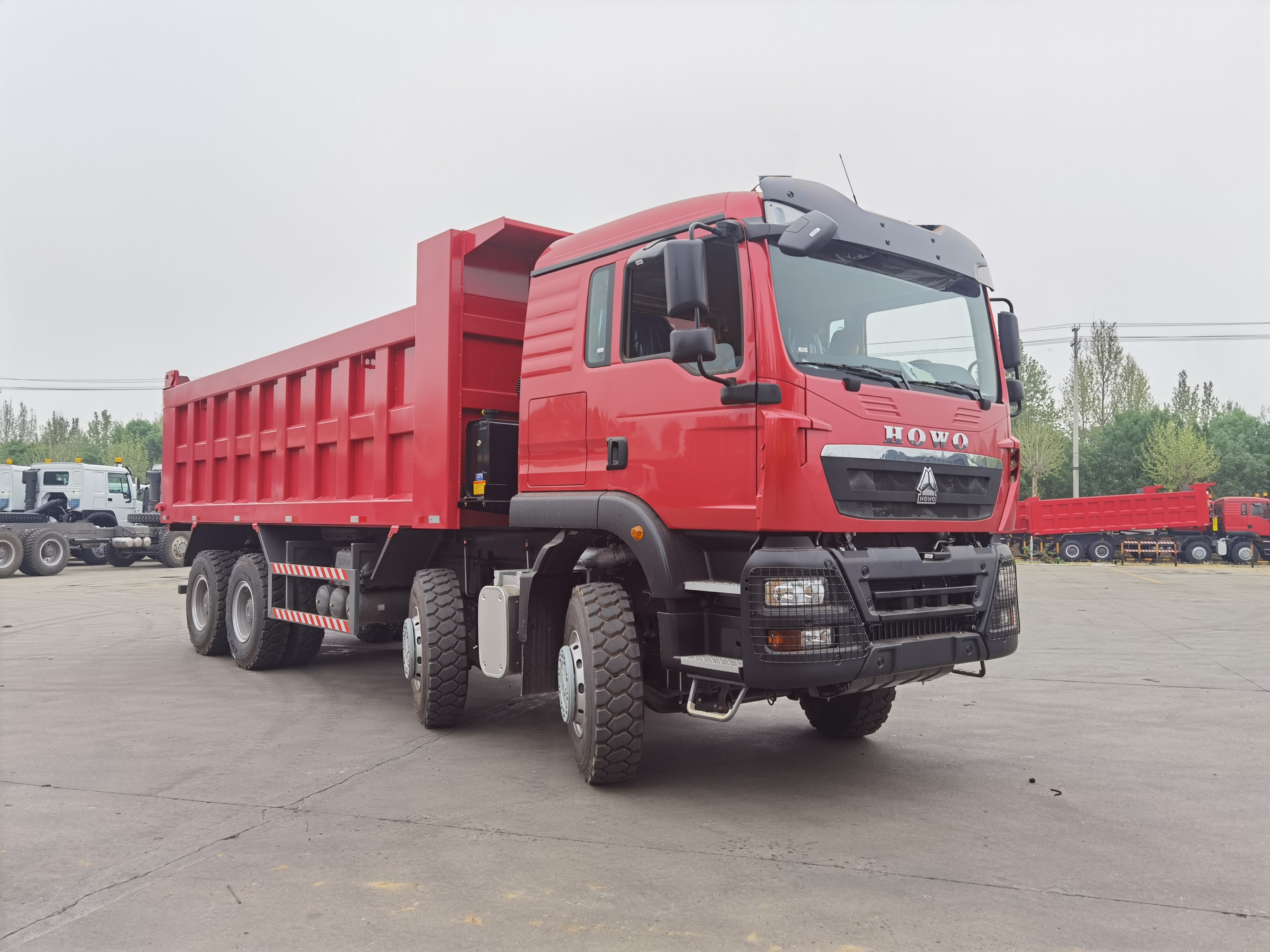
The SINOTRUK HOWO TX 8x4 dump truck, published with a 40-ton rated load and 25–30 CBM cargo volume. Photo: QINGONG.
A distributor comparing the SINOTRUK HOWO-TX 6x4 dump truck (model ZZ3257V3847GB1) with the SINOTRUK HOWO TX 8x4 dump truck (chassis code ZZ3317V386GB1) is not comparing two trim levels of one vehicle. Drive layout, cargo volume, rated load and the applications each unit's published specification names all differ, and those differences decide which customer profile each truck can serve.
The short version: the 8x4 is the higher-capacity unit, published with 25–30 CBM of cargo volume and a 40-ton rated load. The 6x4 is the three-axle unit, published with a 371 HP WD615.47 engine, a 5400x2300x1500 mm cargo box, an HW19710 ten-speed transmission and a considerably more detailed mechanical specification. Neither truck substitutes for the other. The right stock decision depends on what your market hauls, how far it hauls it, and over what surface.
This guide is written for SINOTRUK global distributors, importers and overseas dealers evaluating HOWO TX dump trucks for stock, tender response or fleet supply. It works from the published specification of each model. Where a figure exists for one truck but not the other, it says so rather than borrowing the number across.
The distributor decision: configuration before specification
A retail buyer asks which truck fits one site. A distributor asks which configuration will fit enough sites across a territory to justify stocking it, stocking its parts, and training technicians on it. That is a different question, and it changes what you compare first.
Three consequences follow.
- The unit of decision is the market, not the customer. A single order shows one customer's haul profile. A stock commitment assumes a recurring profile across your territory. Confusing the two leaves slow-moving inventory and a parts shelf nobody draws from.
- A quoted specification becomes a document someone will check against. Once a distributor resells against a spec sheet, small items — a model code, a plate thickness, an emission level — become the points where a delivery is verified and, if necessary, questioned.
- Support cost scales with variant count. Two dump truck variants mean two parts conversations, two technician briefings and two sets of documentation. Where the variants share components, the burden is lower than the axle count suggests.
That is why this comparison starts with drive layout and load class, moves into engine and body detail, and finishes with the items a quotation has to confirm in writing.
Industry background: the channel a HOWO distributor plugs into
Sinotruk's export base is large enough that distributors compete on service rather than on access to vehicles. Sinotruk (Hong Kong) Limited reported heavy-duty truck export volume of 134,038 units in 2024 in its annual report, a figure covering international heavy-truck shipments rather than domestic sales.
Below the manufacturer, the channel is organised regionally. SINOTRUK International publishes regional contact allocations for Africa: one listed contact covers Senegal, Western Sahara, Mauritania, Gambia, Cape Verde, Guinea, Guinea-Bissau and Mali, while another covers Benin, Burkina Faso, Togo, Ghana, Côte d'Ivoire, Liberia and Sierra Leone. A contact allocation is a routing and verification starting point, not proof that a named national distributor has been appointed in any of those countries. Distributors and importers should read it that way — it tells you who to ask, not who is already authorised.
QINGONG (JINAN QINGONG INTERNATIONAL TRADE CO.,LTD) operates in the export layer of that channel. Founded in 2008 and based in Jinan City, Shandong Province, China, the company's published profile records a 4,500 m² facility, approximately 300 employees, an 80-engineer R&D team and annual production capacity of 3,000 units. Its profile describes it as an official exporter of SINOTRUK, SHACMAN and FAW, notes cooperation with BEIBEN, Dongfeng, FOTON, XCMG, SHANTUI, SEM and SANY, and lists OEM, ODM and customized manufacturing services. It reports exports to more than 100 countries, annual sales above USD 200 million, and subsidiaries established since 2023 in Tanzania, Indonesia, Zambia and Laos.
For a distributor, that combination — manufacturer-adjacent sourcing plus regional subsidiaries — shortens the distance between a stock decision and a service answer. It does not remove the need to confirm the specification of the specific model you intend to order.
The HOWO TX 6x4 dump truck, specified
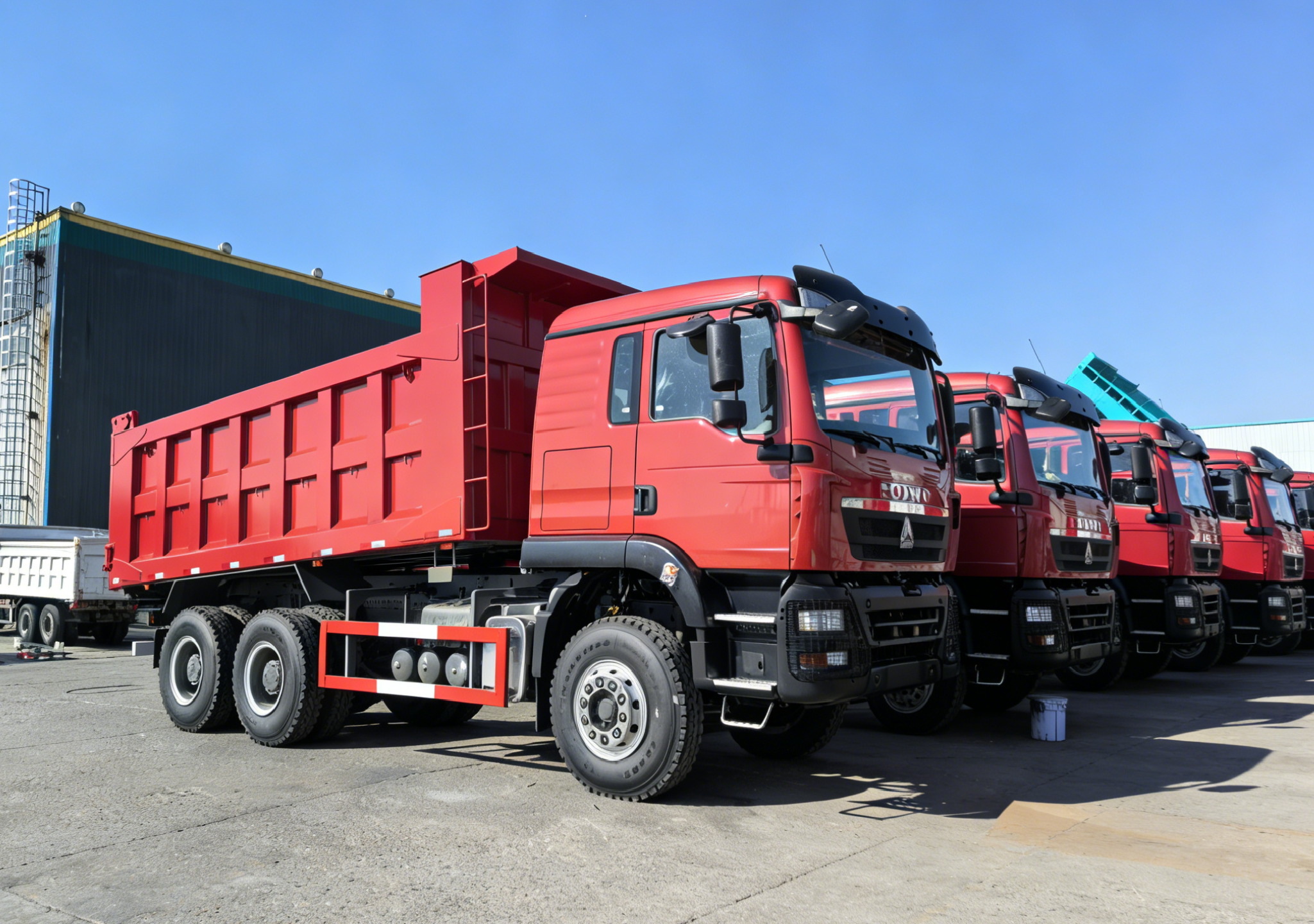
SINOTRUK HOWO TX 6x4 dump truck, model designation ZZ3257V3847GB1. Photo: QINGONG.
The SINOTRUK HOWO-TX 6x4 dump truck is published under model designation ZZ3257V3847GB1, with the specification sheet listing the model as ZZ3257V384GB1. Its published configuration is:
- Drive: 6x4, left-hand drive
- Engine: WD615.47, 371 HP, Euro II
- Transmission: HW19710, 10 forward gears and 2 reverse gears
- Cargo box: 5400 x 2300 x 1500 mm, bottom plate 8 mm, side plate 6 mm, middle lifting system
- Overall dimensions: 8400 x 2500 x 3400 mm
- Front axle: VGD95 with drum brake; rear axle: MCX16ZG, gear ratio 5.451
- Cabin: TX-F cab with single bunk, air conditioning, safety belts, and front and rear lamp covers
- Fuel tank: 300 L with cap lock
- Tires: 12.00R20 radial, with one spare tire
- Material: steel; color: red and white
- Published applications: construction, mining and building, with cement and concrete work added in the product description
The level of detail is itself useful. A distributor quoting this unit can supply a customer with axle ratio, body plate thickness, transmission model and lifting type without going back to the factory for each item — the kind of information a tender document or a fleet engineer will ask for early.
One detail to resolve before you quote
The product is designated ZZ3257V3847GB1, while the specification sheet lists ZZ3257V384GB1. That is not a reason to avoid the model, but it is a reason to fix the code on every quotation, proforma invoice and shipping document before a customer sees it. Ask the supplier which code appears on the vehicle documentation for the units you are ordering, then use that one consistently across your own paperwork.
The HOWO TX 8x4 dump truck, specified
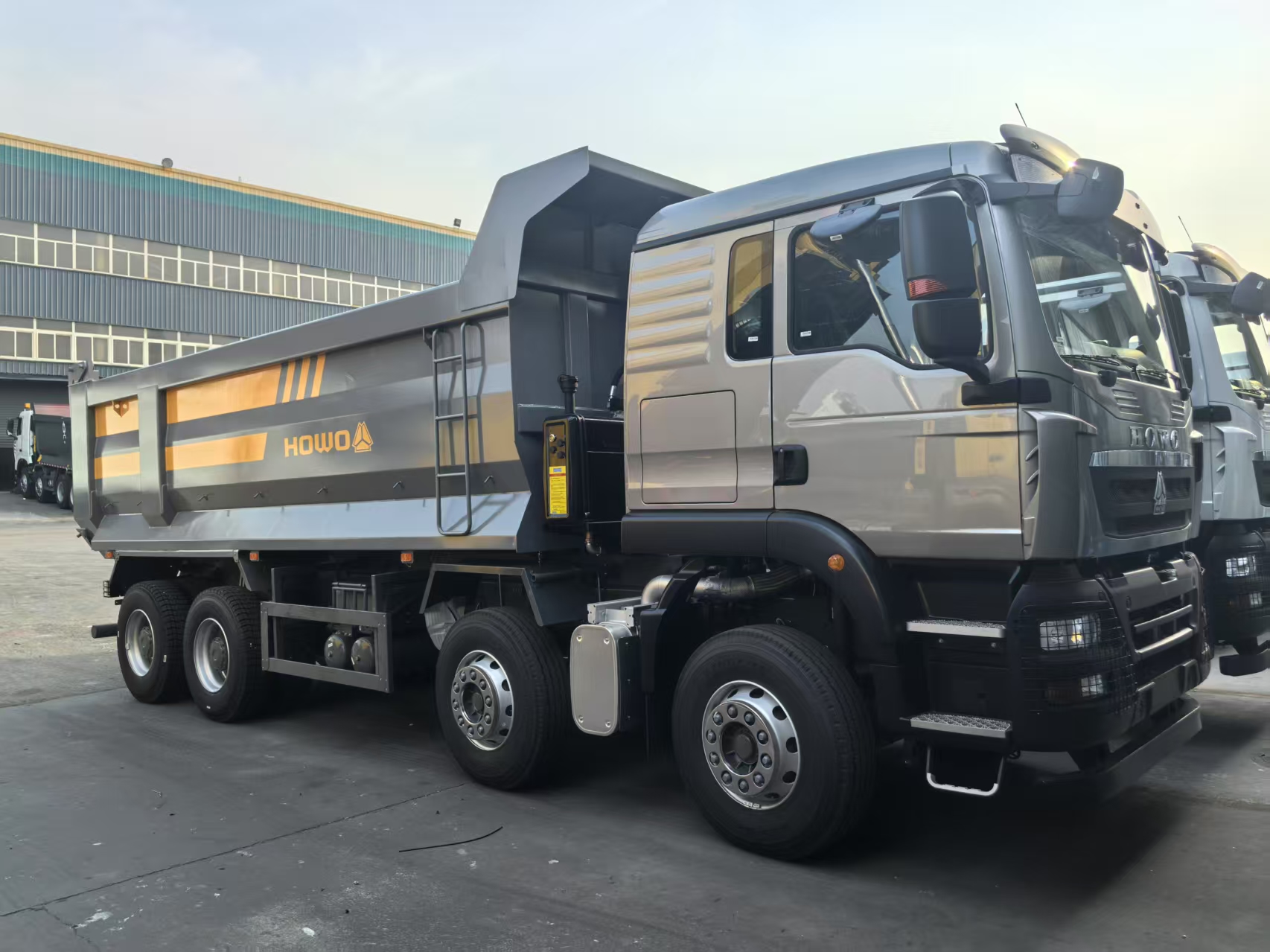
SINOTRUK HOWO TX 8x4 dump truck, chassis code ZZ3317V386GB1. Photo: QINGONG.
The SINOTRUK HOWO TX 8x4 Dump Truck is published under chassis code ZZ3317V386GB1. Its published configuration is shorter:
- Drive: 8x4
- Rated load capacity: 40 tons
- Cargo volume: 25–30 CBM
- Cabin: TX-F single sleeper cab with air conditioner and safety belt
- Material: carbon steel
- Published applications: mining, construction, building and road building
Two figures that most affect a tender response — rated load and cargo volume — are published for this unit but not for the 6x4. The reverse is true for engine, transmission, axles, overall dimensions and emission standard, which are published for the 6x4 but are not part of the 8x4 specification set used here. A distributor should treat that asymmetry as a task, not as a gap to fill by assumption.
Side-by-side comparison
| Specification | HOWO TX 6x4 (ZZ3257V3847GB1) | HOWO TX 8x4 (ZZ3317V386GB1) |
|---|---|---|
| Drive configuration | 6x4 | 8x4 |
| Rated load capacity | Not stated in the published specification | 40 tons |
| Cargo volume / body | Box 5400 x 2300 x 1500 mm (approximately 18.6 m³, calculated) | 25–30 CBM |
| Body plate thickness | Bottom 8 mm, side 6 mm | Not stated |
| Lifting system | Middle lifting system | Not stated |
| Engine | WD615.47, 371 HP, Euro II | Not stated |
| Transmission | HW19710, 10 forward / 2 reverse | Not stated |
| Front / rear axle | VGD95 drum brake / MCX16ZG, ratio 5.451 | Not stated |
| Cabin | TX-F cab, single bunk, A/C, safety belts | TX-F single sleeper cab, A/C, safety belt |
| Overall dimensions | 8400 x 2500 x 3400 mm | Not stated |
| Fuel tank | 300 L with cap lock | Not stated |
| Tires | 12.00R20 radial, one spare | Not stated |
| Steering | Left-hand drive | Not stated |
| Material | Steel | Carbon steel |
| Color | Red / white | Not stated |
| Published applications | Construction, mining, building (plus cement and concrete) | Mining, construction, building, road building |
Rows marked “not stated” are exactly that. They are not zero, and they are not identical to the other column. A distributor who fills them in from memory is quoting something the supplier has not published.
What the numbers change in the field
Payload and volume answer different questions
Rated load governs how much mass a truck is rated to carry. Cargo volume governs how much space the body offers. Bulk material with low density — overburden, light spoil, some aggregates — runs out of volume before it runs out of payload. Dense material — ore, wet sand, heavy rubble — runs out of payload first, with body space left over.
The 8x4's published 40-ton rated load paired with a 25–30 CBM body describes a truck dimensioned for heavy, dense loads. The 6x4 is published with a defined box of 5400 x 2300 x 1500 mm; converting those internal dimensions gives approximately 18.6 m³ of nominal geometric volume (5.4 x 2.3 x 1.5 m, calculated, before any allowance for body structure or load heaping). Its rated payload is not part of the published specification, so this article does not state one — and a distributor should not derive one from the 8x4 figure or from the box volume alone.
Body construction and material
The 6x4 body is published with an 8 mm bottom plate, 6 mm side plates and a middle lifting system. The 8x4 is published as carbon steel, without plate thicknesses or lifting type in the specification set used here. For abrasive applications, plate thickness is a question a customer will ask sooner or later. Pre-empt it: request the 8x4 body specification in writing rather than assuming it matches the 6x4.
Cab family and driver pool
Both units list a TX-F cab. The 6x4 is published as a TX-F cab with single bunk, air conditioning and safety belts, plus front and rear lamp covers. The 8x4 is published as a TX-F single sleeper cab with air conditioner and safety belt. Where the cab family is shared, driver familiarisation and cab-related parts conversations stay inside one family across a mixed fleet — a practical advantage for a distributor whose customers may run both configurations on different sites.
Axle count and site geometry
An 8x4 spreads load across four axles; a 6x4 across three. On unpaved haul roads and in confined loading areas, that difference affects how weight is distributed and how the vehicle behaves in tight working zones. The 6x4's overall dimensions are published at 8400 x 2500 x 3400 mm; the 8x4's overall dimensions are not part of the supplied specification. Before recommending an 8x4 into a site with narrow benches or restricted turning space, obtain its actual dimensions and turning data rather than inferring them from axle count.
What this comparison cannot tell you
- Price, MOQ, lead time, payment terms and freight: not part of the supplied data.
- 8x4 engine model, output, transmission and emission standard: not stated in the specification used here.
- 6x4 rated load capacity: not stated.
- Warranty terms, service intervals and parts pricing for either unit: not stated.
None of these is a defect in either truck. They are the items a distributor closes out with a written quotation before committing stock, and they are exactly the items a serious buyer will ask about in the evaluation stage.
A step-by-step selection process for distributors
Step 1 — Profile the haul, not the customer
Write down the material type, its density behaviour (bulky or dense), the one-way distance, the road surface and the width of the loading and tipping areas. One page per customer segment is enough. This profile, not the customer's preference for a bigger-looking truck, drives the configuration decision.
Step 2 — Decide whether volume or payload binds first
If the material is bulky and light, the body fills before the rated load is reached, and cargo volume becomes the limiting figure — which points toward the 8x4's 25–30 CBM. If the material is dense, payload binds first and the rated load becomes the governing figure. Where the haul is mixed, the two models stop being alternatives and become a two-model answer.
Step 3 — Match the body to the material
For the 6x4, the published 8 mm bottom and 6 mm side plates with a middle lifting system give a definable baseline to quote. For the 8x4, obtain plate thickness and lifting configuration before quoting a body for abrasive or impact-heavy work.
Step 4 — Fix the model code and configuration on paper
Resolve the 6x4's published code question (ZZ3257V3847GB1 versus the ZZ3257V384GB1 shown on the specification sheet) before the first quotation leaves your office. Confirm in writing which code will appear on vehicle documentation, and use it consistently in tenders, proforma invoices and customs paperwork.
Step 5 — Confirm emission and market requirements with the importing authority
The 6x4 is published as Euro II with a WD615.47 engine. The 8x4's emission standard is not stated in the supplied specification. Because registration requirements differ between markets and change over time, confirm the applicable requirement with the relevant importing or registering authority in the destination country, then match it against the written specification of the exact unit you intend to ship.
Step 6 — Plan parts coverage around the variants you stock
Decide which consumables and wear parts you will hold for each variant before the first unit lands. The shared TX-F cab family reduces the breadth of that list. Engine, transmission and axle parts follow the configuration you actually stock, so a market that buys mostly 6x4 units should carry 6x4-specific wear items, not a generic dump truck kit.
Step 7 — Validate with a pilot unit before a volume commitment
Place one unit into the duty cycle you intend to sell into, and record fuel use, uptime, body wear and driver feedback against your own baseline. A pilot does not prove fleet-wide performance, but it does convert a brochure claim into a locally observed figure you can quote to the next customer.
Use-case fit: mining, construction, building and road building
Mining
Both models list mining among their published applications. The 8x4's 40-ton rated load and 25–30 CBM body suit dense ore and overburden haulage where payload per cycle drives cost. The 6x4's published 371 HP engine, 5.451 rear axle ratio and 12.00R20 tires describe a three-axle unit for mine support work, ramp and bench duties, and sites where the haul road or loading area constrains vehicle size. Neither application list is a performance guarantee for a specific pit; it indicates intended duty.
Construction and building
Both units list construction and building. On urban and semi-urban sites, the 6x4's published overall dimensions of 8400 x 2500 x 3400 mm give a definable footprint to check against gate widths, site roads and tipping points — a practical advantage when a customer needs an answer before ordering. For high-volume aggregate and spoil movement across a larger site, the 8x4's cargo volume and rated load reduce the number of cycles required for the same tonnage.
Road building
Road building appears in the published application list of the 8x4 unit and not in the 6x4's published list, which names construction, mining and building, with cement and concrete added in the product description. That distinction is worth respecting when a distributor responds to a road contractor's enquiry: match the quoted model to the application the specification actually names, and confirm any adjacent use directly with the supplier.
Mixed fleets
Where a customer runs both configurations, the shared TX-F cab family keeps driver training and cab parts inside one family, while the differences in body volume and rated load let the fleet split work: larger volumes and heavier rated loads on the high-tonnage circuits, compact three-axle units on constrained or mixed sites. This is a stocking logic, not a claim about any specific customer's results.
Building a two-model stock mix
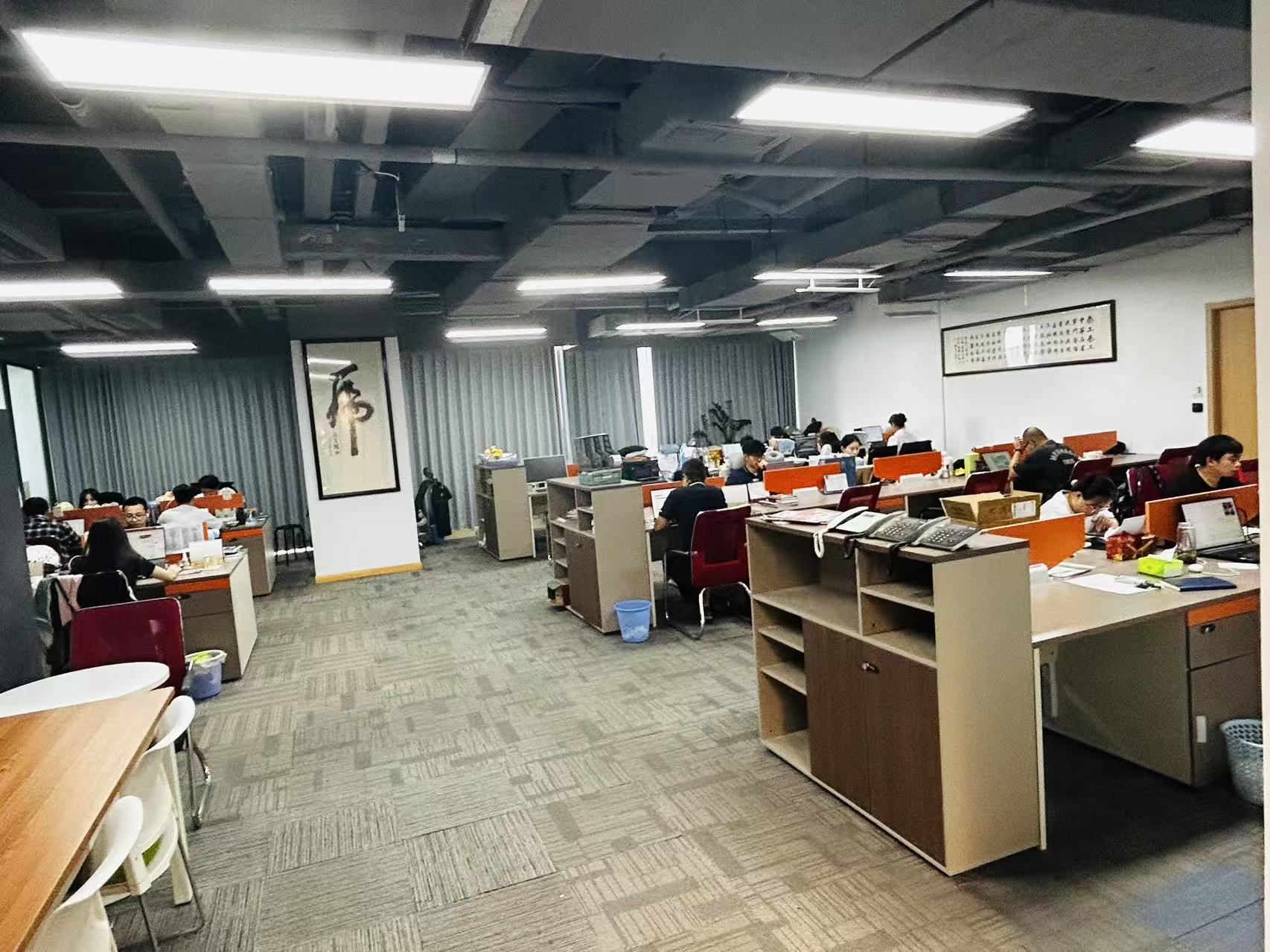
QINGONG's Jinan base, where HOWO TX distributor enquiries are handled. Photo: QINGONG.
A distributor with limited capital rarely needs to choose one model and exclude the other. The more defensible position is a documented mix: a small number of 8x4 units for tenders that specify high rated load and high volume, and 6x4 units for the recurring site work that makes up the base of the market. What matters is that the mix is justified by the haul profiles you can actually name, not by a wish to display a full range.
For markets in West Africa, the practical starting point is the official regional contact structure described earlier. Use those contacts to establish the authorised route for your territory, then bring the configuration questions — model code, body specification, emission standard, parts availability — to the supplier in writing. Where a distributor works through an exporter such as QINGONG, the same questions apply; the exporter's published capability, including a 4,500 m² facility, 80 engineers, 3,000-unit annual capacity and subsidiaries in Tanzania, Indonesia, Zambia and Laos since 2023, indicates the scale of support available, not a substitute for model-specific confirmation.
For distributors who need customized units, QINGONG lists OEM, ODM and customized manufacturing services. Any customization should be specified against the published baseline of the model you are modifying, so that the difference between standard and customized configuration stays visible on the paperwork.
Limitations and what to confirm in writing
An honest comparison has to name what it cannot settle. For this pair, the open items are the 6x4's rated load capacity, the 8x4's engine, transmission, emission standard and overall dimensions, body plate thickness and lifting type for the 8x4, and commercial terms for both. Price, MOQ, lead time and freight are outside the supplied data entirely.
Two further cautions belong in any distributor's file. First, published application lists indicate intended duty; they are not a statement that a truck will perform to a specific productivity figure on a specific site. Second, distributed regional contacts and public profiles show where to start a verification, not what has been verified. Both cautions protect the distributor more than they inconvenience the buyer.
Frequently asked questions
What should global distributors check when sourcing China heavy truck suppliers?
Check five things in writing: the supplier's authorisation and its documentary evidence; the exact model code that will appear on the vehicle documentation; the published specification for the specific model, not the product family; production and engineering capacity; and parts and service coverage for the configuration you intend to stock. As an example of the capacity data to request, QINGONG's published profile records a 4,500 m² facility, approximately 300 employees, an 80-engineer R&D team, 3,000-unit annual production capacity, exports to more than 100 countries, and subsidiaries in Tanzania, Indonesia, Zambia and Laos established since 2023. Treat authorisation statements as items to confirm rather than items to repeat.
Is the HOWO TX 8x4 dump truck a direct replacement for the 6x4?
No. The two units differ in drive layout, published capacity and published applications. The 8x4 is published with 8x4 drive, a 40-ton rated load, 25–30 CBM cargo volume and applications covering mining, construction, building and road building. The 6x4 is published with 6x4 drive, a 371 HP WD615.47 Euro II engine, an HW19710 transmission, a 5400 x 2300 x 1500 mm cargo box and applications covering construction, mining and building. Whether one can replace the other depends on the haul profile, not on engine output alone.
How much cargo does the HOWO TX 6x4 dump truck carry?
The published cargo box measures 5400 x 2300 x 1500 mm, with an 8 mm bottom plate, 6 mm side plates and a middle lifting system. Converting those internal dimensions gives approximately 18.6 m³ of nominal geometric volume, a calculated figure rather than a measured one. The truck's rated load capacity is not stated in the published specification, so any payload figure should be obtained from the supplier in writing before it is quoted to a customer.
Which HOWO TX dump truck is specified for road building?
Road building appears in the published application list of the SINOTRUK HOWO TX 8x4 dump truck, alongside mining, construction and building. The 6x4's published list covers construction, mining and building, with cement and concrete work added in the product description. Application lists indicate intended duty rather than a site-specific performance guarantee, so confirm adjacent uses directly with the supplier.
Why does the HOWO TX 6x4 model code appear in two forms?
The product is designated ZZ3257V3847GB1, while the model shown on the specification sheet is ZZ3257V384GB1. The difference should be resolved before quoting: ask which code appears on the vehicle documentation for the units you are ordering, then use that code consistently on quotations, proforma invoices and shipping paperwork. Treating a model code as a formality is how a delivery dispute starts.
What is not covered by the published specifications, and how do I close the gaps?
Not covered: the 6x4's rated load capacity; the 8x4's engine, transmission, emission standard and overall dimensions; 8x4 body plate thickness and lifting type; and price, MOQ, lead time and freight for both models. Close them by requesting a written specification and quotation for the exact configuration you intend to order, together with the current product catalogue. QINGONG publishes its 2026 product catalogue for download at Qingong Group Products Catalog 2026, and handles HOWO TX configuration and quotation enquiries through its Jinan office.
Conclusion
The HOWO TX 6x4 and 8x4 dump trucks are not competing for the same order. The 6x4 brings a fully published mechanical specification — 371 HP WD615.47 engine, 10-speed HW19710 transmission, 5.451 rear axle ratio, 5400 x 2300 x 1500 mm body and 8400 x 2500 x 3400 mm overall dimensions — plus a rated load figure that must be confirmed before it is quoted. The 8x4 brings a published 40-ton rated load and 25–30 CBM cargo volume, with engine, transmission and emission data that must be confirmed before it is quoted.
For a SINOTRUK global distributor, the decision therefore reduces to a documented market review: which materials your customers haul, whether volume or payload constrains them first, how tight their loading areas are, and which specification gaps you can close in writing before a customer asks. Answer those four questions and the configuration choice makes itself. Skip them and either truck can end up as inventory that does not move.
Next step for distributors
Request a written specification and quotation for the HOWO TX 6x4 (ZZ3257V3847GB1) or 8x4 (ZZ3317V386GB1) configuration you intend to stock, and confirm the model code, body specification and emission standard for your market.
QINGONG · www.howoqg.com · Email: qincl@qingong.cn · Tel / WhatsApp: +86 13658632022 · Jinan City, Shandong Province, China

HOWO TX 6x4 dump truck — configuration and quotation enquiries are handled by QINGONG. Photo: QINGONG.
Have Questions or Need More Details?
Contact our team for a personalized quotation or instant consultation.
Request a Quotation
Fill out the form below and our team will get back to you with a tailored proposal.
WhatsApp Direct Chat
Prefer to chat in real-time? Message us on WhatsApp for instant assistance & quick answers.
- Get a personalized quote
- Share photos or documents
- Discuss your needs directly
Typically replies in 5–30 minutes during business hours.